Blog
RAG Systems: The Future of Enterprise AI Applications
Combining LLMs with Enterprise Knowledge

On this page
Retrieval-Augmented Generation (RAG) is revolutionizing how enterprises deploy AI by enabling large language models to access, understand, and reason over proprietary data without costly fine-tuning or model retraining.
🎯 What is RAG?
RAG combines two powerful AI capabilities:
- Retrieval: Semantic search to find relevant information from your data
- Generation: LLM-powered response generation using retrieved context
This approach enables AI systems to provide accurate, up-to-date answers grounded in your enterprise knowledge while maintaining the flexibility and reasoning capabilities of large language models.
🏗️ RAG System Architecture
1. Document Processing Pipeline
Documents → Chunking → Embedding → Vector Store

// Example: Processing enterprise documents
const chunks = documentSplitter.split(document, {
  chunkSize: 1000,
  overlap: 200,
  preserveContext: true
});

const embeddings = await embeddingModel.embed(chunks);
await vectorDB.insert(embeddings, metadata);
2. Query Processing
User Query → Embed → Vector Search → Retrieve Top-K → LLM + Context → Response

// Example: Query processing
const queryEmbedding = await embeddingModel.embed(userQuery);
const relevantDocs = await vectorDB.search(queryEmbedding, {
  topK: 5,
  filters: { department: 'engineering' }
});

const response = await llm.generate({
  prompt: userQuery,
  context: relevantDocs,
  temperature: 0.7
});
3. Response Generation
The LLM generates a response using the retrieved context, ensuring accuracy and relevance while maintaining natural language quality.
💡 Key Components of Production RAG
1. Vector Databases
Popular choices for enterprise RAG:
- Pinecone: Managed, scalable, great for production
- Weaviate: Open-source, GraphQL API, hybrid search
- Qdrant: Fast, open-source, built for production scale
- Milvus: Open-source, GPU-accelerated, handles billions of vectors
- pgvector: PostgreSQL extension, familiar tooling
2. Embedding Models
Choose based on your requirements:
- OpenAI text-embedding-3: High quality, 3072 dimensions
- Cohere Embed: Multilingual, optimized for search
- BGE (BAAI): Open-source, SOTA performance
- E5: Microsoft's open model, strong retrieval
3. Chunking Strategies
Effective chunking is critical for RAG performance:
- Fixed-size chunking: Simple, predictable (500-1000 tokens)
- Semantic chunking: Split on topics/sections
- Sliding window: Overlapping chunks for context preservation
- Hierarchical chunking: Multi-level for long documents
🚀 Advanced RAG Techniques
1. Hybrid Search
Combine vector search with traditional keyword search for best results:
// Hybrid search implementation
const vectorResults = await vectorDB.search(queryEmbedding, { topK: 10 });
const keywordResults = await fullTextSearch(query, { topK: 10 });

// Reciprocal Rank Fusion
const combinedResults = reciprocalRankFusion(
  vectorResults,
  keywordResults,
  { k: 60 }
);
2. Re-ranking
Improve relevance with cross-encoder re-ranking:
const rerankedResults = await reranker.rerank({
  query: userQuery,
  documents: retrievedDocs,
  topK: 5
});
3. Query Expansion
Generate multiple query variations for better recall:
const expandedQueries = await llm.generate({
  prompt: `Generate 3 variations of: ${userQuery}`,
  temperature: 0.8
});

const allResults = await Promise.all(
  expandedQueries.map(q => vectorDB.search(embed(q)))
);

const deduplicatedResults = deduplicate(allResults);
4. Contextual Compression
Remove irrelevant information from retrieved documents:
const compressedDocs = await contextualCompressor.compress({
  query: userQuery,
  documents: retrievedDocs,
  maxTokens: 2000
});
🎯 Real-World Use Cases
1. Customer Support Knowledge Base
Challenge: Agents need instant access to product documentation, policies, and past solutions.
Solution: RAG system indexes all support docs, enabling AI to answer 80% of queries instantly.
Results:
- Average handling time reduced by 65%
- Customer satisfaction increased to 4.8/5
- Agent productivity up 3x
2. Legal Document Analysis
Challenge: Lawyers spend hours researching case law and contracts.
Solution: RAG over millions of legal documents with citation tracking.
Results:
- Research time cut from hours to minutes
- Automated contract review saves 40 hours/week per lawyer
- Improved accuracy with source citations
3. DevOps Documentation
Challenge: Engineers need quick answers about infrastructure, runbooks, and best practices.
Solution: RAG system over all DevOps documentation, Confluence pages, and incident reports.
Results:
- 75% reduction in time to find answers
- Onboarding time reduced by 60%
- Incident resolution 50% faster
🔒 Enterprise RAG Best Practices
1. Data Privacy & Security
- Implement role-based access control (RBAC)
- Encrypt vectors at rest and in transit
- Use private deployment for sensitive data
- Implement audit logging for all queries
2. Quality & Accuracy
- Use hybrid search (vector + keyword)
- Implement re-ranking for relevance
- Add citation/source tracking
- Monitor and evaluate answer quality
- Human-in-the-loop for critical decisions
3. Performance & Scale
- Cache frequent queries
- Use approximate nearest neighbor (ANN) search
- Implement query batching
- Monitor latency and optimize slow paths
- Scale vector DB horizontally
4. Evaluation Metrics
Track these KPIs:
- Retrieval precision/recall: Are we finding the right documents?
- Answer accuracy: Are responses correct?
- Latency: Time from query to response (target: <2s)
- User satisfaction: Thumbs up/down feedback
- Cost per query: Embedding + LLM + infrastructure costs
📊 Performance Benchmarks
Production RAG systems at scale:
- Retrieval latency: 50-200ms for vector search
- End-to-end latency: 1-3 seconds including LLM generation
- Accuracy: 85-95% compared to human experts
- Scale: Handles millions of documents, thousands of concurrent users
- Cost: $0.001-0.01 per query (10-100x cheaper than fine-tuning)
🛠️ Implementation Example
Complete RAG system with Pinecone and OpenAI:
import { OpenAI } from 'openai';
import { Pinecone } from '@pinecone-database/pinecone';

class EnterpriseRAG {
  constructor() {
    this.openai = new OpenAI({ apiKey: process.env.OPENAI_API_KEY });
    this.pinecone = new Pinecone({ apiKey: process.env.PINECONE_API_KEY });
    this.index = this.pinecone.index('enterprise-kb');
  }

  async ingest(documents) {
    // 1. Chunk documents
    const chunks = documents.flatMap(doc =>
      this.chunkDocument(doc, { size: 1000, overlap: 200 })
    );

    // 2. Generate embeddings
    const embeddings = await this.openai.embeddings.create({
      model: 'text-embedding-3-large',
      input: chunks.map(c => c.text)
    });

    // 3. Store in vector DB
    await this.index.upsert(
      chunks.map((chunk, i) => ({
        id: chunk.id,
        values: embeddings.data[i].embedding,
        metadata: {
          text: chunk.text,
          source: chunk.source,
          timestamp: Date.now()
        }
      }))
    );
  }

  async query(question, options = {}) {
    // 1. Embed query
    const queryEmbedding = await this.openai.embeddings.create({
      model: 'text-embedding-3-large',
      input: question
    });

    // 2. Search vector DB
    const searchResults = await this.index.query({
      vector: queryEmbedding.data[0].embedding,
      topK: options.topK || 5,
      includeMetadata: true
    });

    // 3. Build context
    const context = searchResults.matches
      .map(match => match.metadata.text)
      .join('\n\n');

    // 4. Generate response
    const completion = await this.openai.chat.completions.create({
      model: 'gpt-4-turbo-preview',
      messages: [
        {
          role: 'system',
          content: 'Answer based on the provided context. Cite sources.'
        },
        {
          role: 'user',
          content: `Context:\n${context}\n\nQuestion: ${question}`
        }
      ],
      temperature: 0.7
    });

    return {
      answer: completion.choices[0].message.content,
      sources: searchResults.matches.map(m => m.metadata.source),
      confidence: searchResults.matches[0].score
    };
  }
}

// Usage
const rag = new EnterpriseRAG();

// Ingest documents
await rag.ingest(myDocuments);

// Query
const result = await rag.query(
  'What is our incident response procedure?'
);

console.log(result.answer);
console.log('Sources:', result.sources);
🔮 Future of RAG
Emerging trends in RAG systems:
- Multimodal RAG: Combining text, images, and video
- Agentic RAG: AI agents that can query multiple sources and reason
- Graph RAG: Leveraging knowledge graphs for better retrieval
- Adaptive RAG: Systems that learn from user feedback
- Real-time RAG: Sub-second latency for interactive applications
📚 Resources
- Watch our RAG implementation tutorials
- Read the complete RAG documentation
- Get expert help building your RAG system
Ready to transform your enterprise data into AI-powered insights? RAG systems are the foundation for accurate, scalable, and cost-effective AI applications.
More from the blog
Observability Is Not Optional: Make It a Business Standard
Why fragmented monitoring creates blind spots, duplicate spend, and slow incidents — and how to make centralised observability a non-negotiable company standard.
WSL Vault for Compliance: One Tenant Never Opens Another’s Secrets
How WSL Vault keeps app, team, and environment tenants cryptographically isolated — so a stolen root-style token cannot empty the estate — and why dual-tenant control beats secrets sprawl.
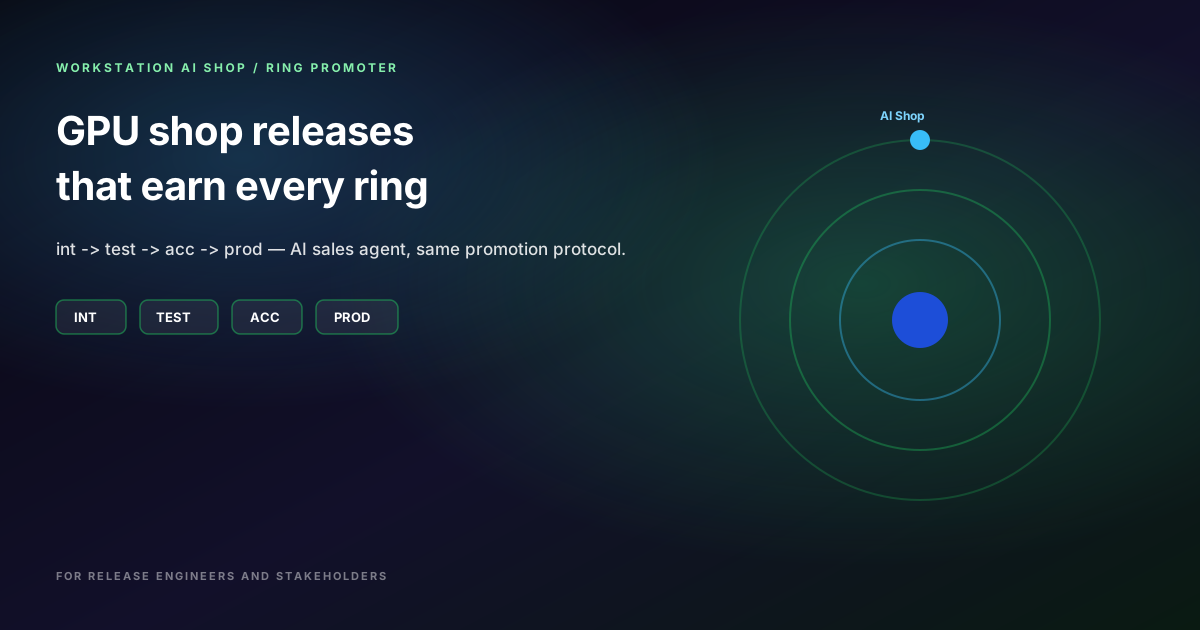
Workstation AI Shop: Promoting the AI Sales Storefront Through int → test → acc → prod
Workstation AI Shop sells GPU machines with a fully autonomous AI Sales Agent that configures the basket. See how Ring Promoter moves each build through int → test → acc → prod — with Orbit screenshots release engineers and stakeholders share.